
Frequently Asked Questions
A live resource, dealing with questions that arise from users of the COM-B model.
-
Yes, they are free to use for research and academic purposes. You can download them here. For commercial use contact us.
-
Yes, please contact us for more information.
-
The core COM-B model focuses on predicting individual behaviour in specific scenarios, recognising that capabilities, opportunities and motivations are different for different individuals and at different moments in time. However, most of the uses are for populations over periods of time. That is why in COM-B 2.0 we are building a ‘population-level’ version in which the key constructs are treated as variables that characterise defined populations.
-
In the updated COM-B model confidence in ability to do a behaviour is a belief that influences reflective motivation, rather than as a subcomponent of capability. There is a nuance, however, in that ‘accuracy of belief in capability to do a behaviour’ comes under capability because it is a kind of knowledge. Thus we can have constructs such as ‘overconfidence’ and ‘underconfidence’ that can be addressed in the way that one would address other misconceptions to improve performance, and somewhat differently from how one would, say, boost confidence to increase motivation.
-
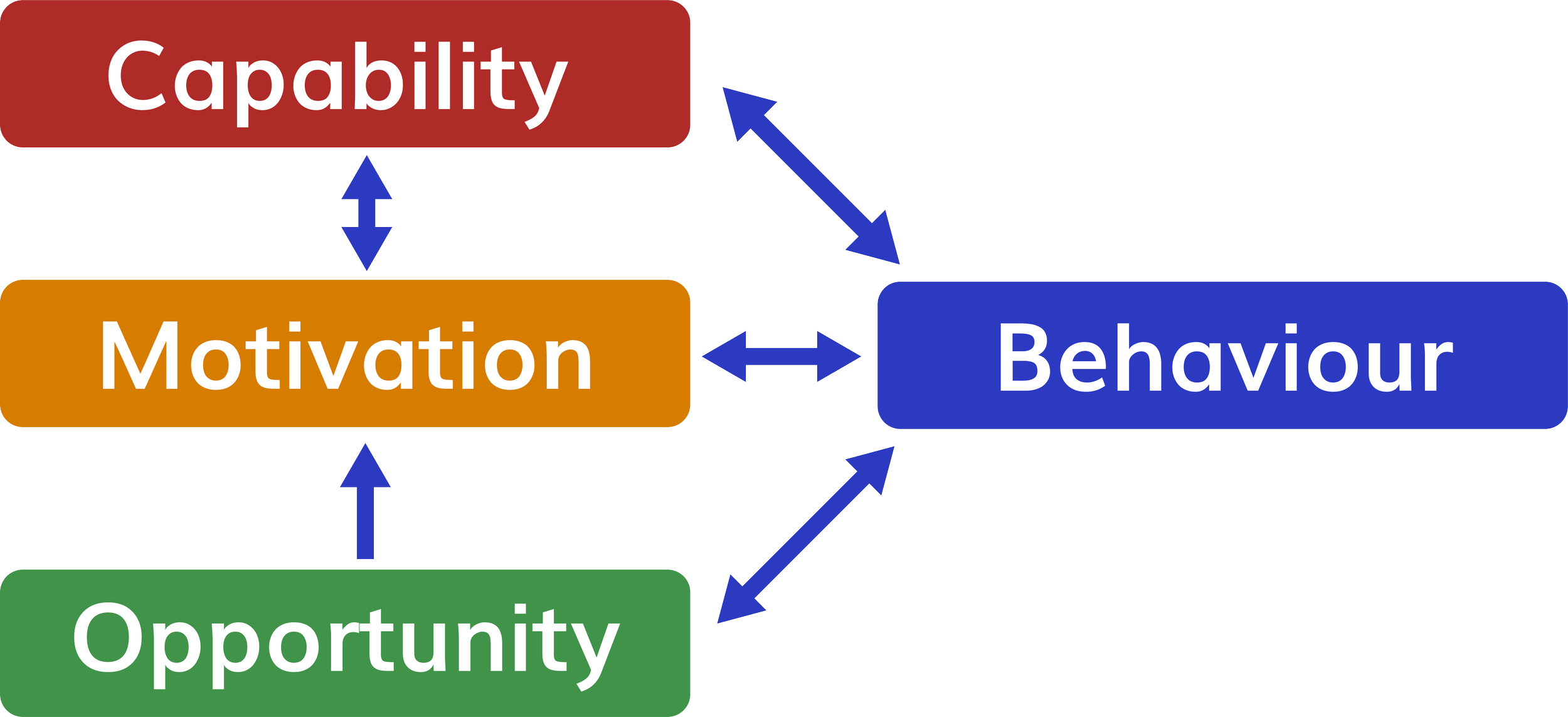
In the original COM-B model there was an arrow between Capability and Motivation but not the other way round. In a revised version, the other arrow was added. This reflects the fact that motivation can have profound effects on capability. An important example of this is ‘wishful thinking’ influencing our understanding of decision scenarios - for example when gamblers overestimate the odds of success of a gamble because they desperately need a win to recover a series of losses.